

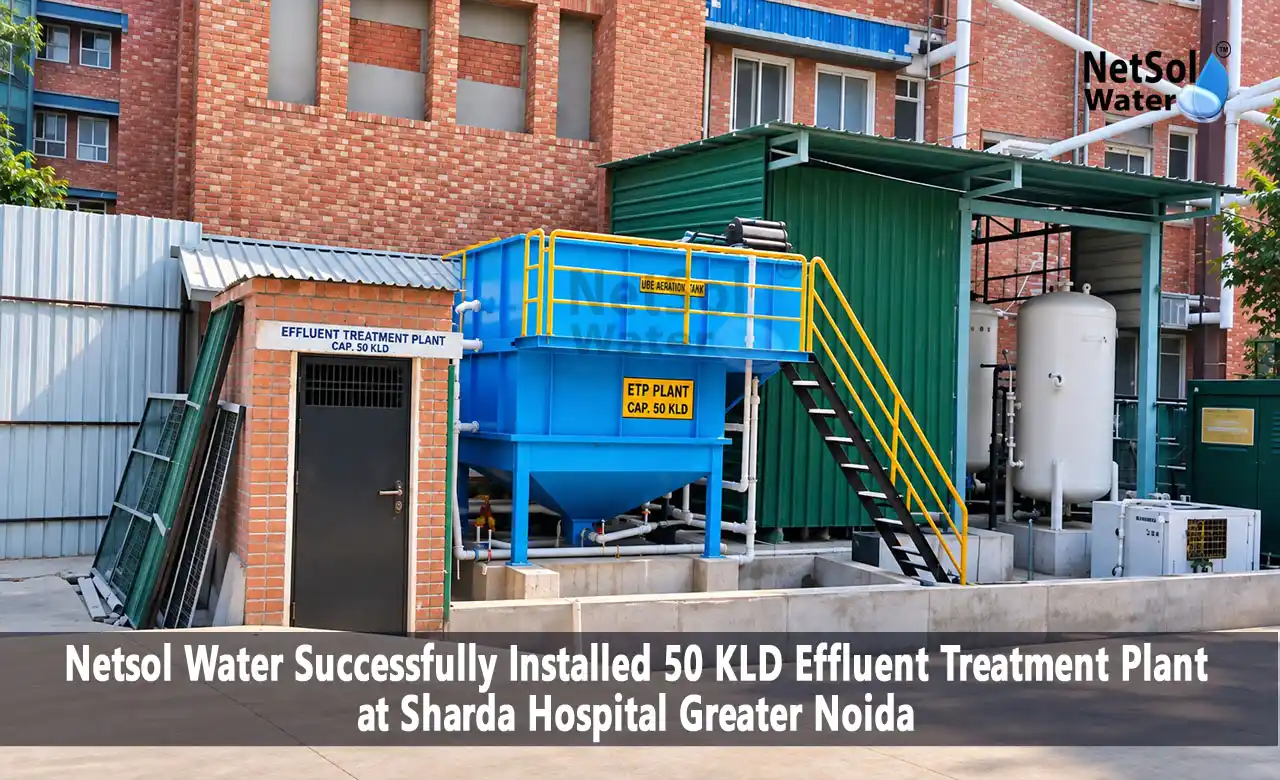
Case Study: Installed 50 KLD ETP Plant at Sharda Hospital, Greater Noida
Hospitals generate wastewater every day through patient care, diagnostics, cleaning and daily operations. Managing this wastewater responsibly is an essential part of running a healthcare facility. As part of this responsibility, Netsol Water installed a 50 KLD ETP Plant at Sharda Hospital, Greater Noida, to treat the wastewater generated within the hospital premises.
This case study explains the project background, the planning process, the treatment approach and the overall execution of this Effluent Treatment Plant in Greater Noida.
| Project Parameter | Details |
|---|---|
| Project | 50 KLD ETP Plant Installation |
| Client | Sharda Hospital |
| Location | Greater Noida, Uttar Pradesh |
| Plant Capacity | 50 KLD |
| Plant Type | Effluent Treatment Plant |
| Application | Hospital Wastewater Treatment |
| Installation Company | Netsol Water |
| YouTube Video | Project Installation Video |
About Sharda Hospital, Greater Noida
Sharda Hospital is a healthcare facility located in Greater Noida, Uttar Pradesh, offering a range of medical services to patients from the region. Like any active hospital, its daily functioning involves several departments, including patient wards, laboratories, operation theatres, laundry, kitchen and general housekeeping.
Each of these departments contributes to the wastewater generated on the premises. Patient care activities, diagnostic testing, sanitation, laundry operations and kitchen use all produce wastewater with varying characteristics. This makes it necessary for a hospital of this scale to have a dedicated system in place to treat wastewater before it is discharged or reused.
Why Wastewater Treatment Is Important in Hospitals
Hospital wastewater is different from ordinary domestic sewage. It often carries a mix of organic waste, suspended solids and other contaminants originating from medical, sanitation and kitchen activities. If this wastewater is released without proper treatment, it can affect the surrounding environment and public health.
A few reasons why treatment matters in a hospital setting include:
. Wastewater is generated continuously from multiple hospital departments
. Sources include wards, laboratories, laundry, kitchen and cleaning operations
. Untreated effluent can carry organic and suspended pollutants
. Systematic treatment helps reduce the pollutant load before discharge or reuse
. Responsible wastewater management supports environmental protection
. Treatment helps hospitals work towards meeting applicable discharge or reuse requirements
This is where an Effluent Treatment Plant becomes essential. In simple terms, an ETP is a system that treats wastewater through a series of physical, biological and chemical steps so that it becomes safer to discharge or, where feasible, reuse.
Project Requirement for the 50 KLD ETP Plant
Sharda Hospital required a wastewater treatment system that could reliably handle the effluent generated across its various departments. The project called for a 50 KLD Effluent Treatment Plant, meaning a system capable of treating 50,000 litres of wastewater per day.
While planning a hospital ETP of this scale, several factors are generally taken into account, such as:
. The expected daily wastewater flow from hospital operations
. Space available for installing the treatment system
. The need for the plant to run continuously and consistently
. Treatment performance suited to hospital wastewater
. Ease of day-to-day operation and maintenance for hospital staff
. Proper handling and management of sludge generated during treatment
. Suitable management of treated water after processing
These considerations guide the overall design of a Hospital ETP Plant so that it functions reliably within the space and operational routine of the facility.
Design and Planning of the 50 KLD ETP Plant
Designing an ETP for a healthcare facility involves a structured planning process. This generally includes:
. A site assessment to understand available space and layout constraints
. Assessment of expected wastewater flow and generation pattern
. Capacity planning based on the required treatment volume, in this case 50 KLD
. Selection of a treatment approach suited to the nature of hospital wastewater
. Selection of appropriate equipment and tankage
. Planning of piping layout for wastewater collection and treated water discharge
. Electrical planning for pumps, blowers and control systems
. Consideration of long-term operation and maintenance needs
This planning stage forms the foundation for a plant that can operate consistently once commissioned.
Treatment Process of the 50 KLD ETP Plant
An Effluent Treatment Plant typically works through a sequence of stages, each performing a specific role in cleaning the wastewater. The general sequence followed in a hospital ETP of this type is explained below as a typical process; the exact configuration of internal stages should be referred to the project's technical documentation.
| Treatment Stage | General Role |
|---|---|
| Wastewater Collection | Wastewater generated from different parts of the hospital is collected through a drainage network and directed towards the treatment plant. |
| Screening | Removes larger floating and coarse solids at the entry point, protecting downstream equipment from damage or blockage. |
| Equalization | Balances variations in flow rate and wastewater characteristics, allowing later stages to work more consistently. |
| Primary Treatment | Focuses on removing settleable solids and other readily separable pollutants from the wastewater. |
| Biological Treatment | Uses microorganisms to break down biodegradable organic matter, reducing the overall organic load. |
| Clarification | Allows solids to separate from the treated water through settling, producing a clearer effluent stream. |
| Filtration | Further reduces remaining suspended particles, improving the quality of the treated water. |
| Disinfection | Helps control microbial content in the treated water before discharge or reuse. |
| Sludge Management | Collects and manages sludge generated during the various treatment stages. |
It should be noted that this sequence represents a general hospital ETP process. Specific stage-by-stage configuration for the Sharda Hospital plant should be confirmed through the project's engineering documentation.
Major Components of the ETP Plant
| Component | Purpose |
|---|---|
| Collection System | Receives wastewater from hospital departments |
| Screening System | Removes coarse solids |
| Equalization Tank | Balances wastewater flow |
| Biological Treatment Unit | Reduces biodegradable pollutants |
| Clarifier | Separates solids from treated water |
| Filtration Unit | Reduces remaining suspended particles |
| Disinfection Unit | Controls microorganisms in treated water |
| Sludge Handling System | Manages generated sludge |
| Pumps | Transfer wastewater and treated water |
| Control Panel | Controls electrical operation of the plant |
Installation of the 50 KLD ETP Plant at Sharda Hospital
The installation of the 50 KLD ETP Plant at Sharda Hospital was carried out in a structured manner by the Netsol Water team. The general execution process for a project of this nature includes:
. Site inspection to confirm layout and installation requirements
. Equipment planning based on the finalized design
. Delivery of tanks, machinery and associated equipment to site
. Positioning of equipment at designated locations
. Installation of tanks and interconnecting piping
. Installation of pumps and mechanical components
. Electrical wiring and control panel setup
. Interconnection of all process units
. Testing of installed equipment
. Trial operation to observe plant behaviour under working conditions
. Final commissioning of the plant
A careful and methodical installation process like this helps ensure that the plant operates reliably once it is handed over for regular use.
Project Execution and Commissioning
Once installation work was completed, the plant went through a commissioning process to confirm it was ready for regular operation. This generally involves:
. Mechanical inspection of installed equipment
. Piping inspection to check for correct connections
. Electrical inspection of wiring and control systems
. Testing of pumps and other equipment
. Trial operation under actual working conditions
. Flow verification across the treatment stages
. Leakage checking at joints and connections
. Observation of the overall treatment process
. Final commissioning of the plant for regular use
This structured commissioning approach helps confirm that the 50 KLD ETP Plant is functioning as intended before it is put into daily use.
Watch the 50 KLD ETP Plant Installation at Sharda Hospital
To get a closer look at how this project was executed on site, readers can watch the installation video of the 50 KLD ETP Plant at Sharda Hospital, Greater Noida. The video gives a practical view of the equipment, layout and installation work carried out at the hospital premises.
Key Benefits of the 50 KLD ETP Plant
. Systematic treatment of wastewater generated across the hospital
. Treatment capacity of 50,000 litres of wastewater per day
. Better overall management of hospital wastewater
. Reduction of pollutants present in the wastewater stream
. More organized and consistent effluent handling
. Support for the hospital's environmental management practices
. Potential for treated water reuse where applicable and permitted
. Improved operational control over the wastewater treatment process
. Proper and systematic management of generated sludge
Operation and Maintenance of the ETP Plant
Like any treatment system, an ETP requires regular operation and maintenance to continue performing reliably. Key maintenance activities include:
| Maintenance Activity | Purpose |
|---|---|
| Daily inspection | Confirms the plant is running as expected |
| Pump and motor checking | Ensures mechanical components stay functional |
| Routine cleaning | Keeps tanks and units free of buildup |
| Sludge management | Prevents accumulation and supports treatment efficiency |
| Filter maintenance | Maintains filtration performance |
| Electrical panel inspection | Ensures safe and stable operation |
| Disinfection monitoring | Supports microbial control, where applicable |
| Treated water quality testing | Verifies treatment performance periodically |
| Preventive maintenance | Reduces the risk of unexpected breakdowns |
| Scheduled servicing | Maintains long-term reliability of equipment |
Netsol Water can provide technical support and AMC (Annual Maintenance Contract) services for hospitals and facilities that require ongoing assistance in keeping their ETP systems running smoothly.
Project Results
| Parameter | Details |
|---|---|
| Plant Capacity | 50 KLD |
| Daily Treatment Capacity | 50,000 Litres |
| Location | Sharda Hospital, Greater Noida |
| Application | Hospital Wastewater Treatment |
| Plant Type | Effluent Treatment Plant |
| Installation | Netsol Water |
Specific water quality parameters such as BOD, COD, TSS or pH should be referred to the project's testing and laboratory reports, as these values are not included as part of this case study.
Why Choose Netsol Water for ETP Projects?
Netsol Water works as an Effluent Treatment Plant Manufacturer, offering services that span the full project lifecycle, including:
. ETP design based on client requirements
. Manufacturing of treatment equipment
. On-site installation
. Commissioning of the treatment plant
. Customized wastewater treatment solutions for different facility types
. Operation and maintenance support
. AMC services for long-term plant reliability
As an ETP Plant Manufacturer in Greater Noida, Netsol Water focuses on delivering treatment systems that are suited to the specific requirements of each project, whether for hospitals, industries or other institutional facilities.
Conclusion
The installation of the 50 KLD ETP Plant at Sharda Hospital, Greater Noida, reflects a structured approach to hospital wastewater management. From initial planning to final commissioning, the project was executed to help the hospital treat its daily wastewater in a more organized and responsible manner.
Hospital wastewater treatment plays an important role in supporting environmental management within healthcare settings, and this project adds to that ongoing effort at Sharda Hospital. With the treatment system now in place, regular operation and maintenance will remain key to sustaining its performance over time. Netsol Water was involved in the design, installation and commissioning of this plant, and continues to support hospitals and institutions with wastewater treatment solutions suited to their operational needs.
Frequently Asked Questions (FAQs)
Q1. What is the capacity of the ETP installed at Sharda Hospital?
The ETP installed at Sharda Hospital, Greater Noida, has a treatment capacity of 50 KLD, which means it can treat 50,000 litres of wastewater per day generated across the hospital's various departments.
Q2. Where was the 50 KLD ETP Plant installed?
The plant was installed at Sharda Hospital, located in Greater Noida, Uttar Pradesh, to treat wastewater generated from hospital operations, patient care activities and other facility functions.
Q3. What does 50 KLD mean in an ETP Plant?
KLD stands for Kilolitres per Day. A 50 KLD ETP Plant is designed to treat 50,000 litres of wastewater every day, based on the daily wastewater generation of the facility it serves.
Q4. Why is an ETP required in a hospital?
Hospitals generate wastewater from wards, laboratories, laundry, kitchens and sanitation activities. An ETP treats this wastewater systematically, helping reduce pollutants before discharge or reuse and supporting responsible environmental management.
Q5. What type of wastewater is treated by a hospital ETP?
A hospital ETP typically treats wastewater originating from patient care areas, diagnostic laboratories, laundry operations, kitchens and general housekeeping activities carried out within the hospital premises.
Q6. How much wastewater can a 50 KLD ETP treat?
A 50 KLD ETP is designed to treat up to 50,000 litres of wastewater per day, making it suitable for facilities with a similar daily wastewater generation volume, such as a hospital of comparable scale.
Q7. How is a hospital ETP operated and maintained?
Operation and maintenance involve daily inspection, regular checking of pumps and motors, cleaning, sludge management, filter maintenance and periodic testing of treated water quality to keep the plant functioning reliably.
Q8. Can Netsol Water provide customized hospital ETP solutions?
Yes, Netsol Water designs and installs customized ETP solutions for hospitals based on their specific wastewater generation, available space and operational requirements.