

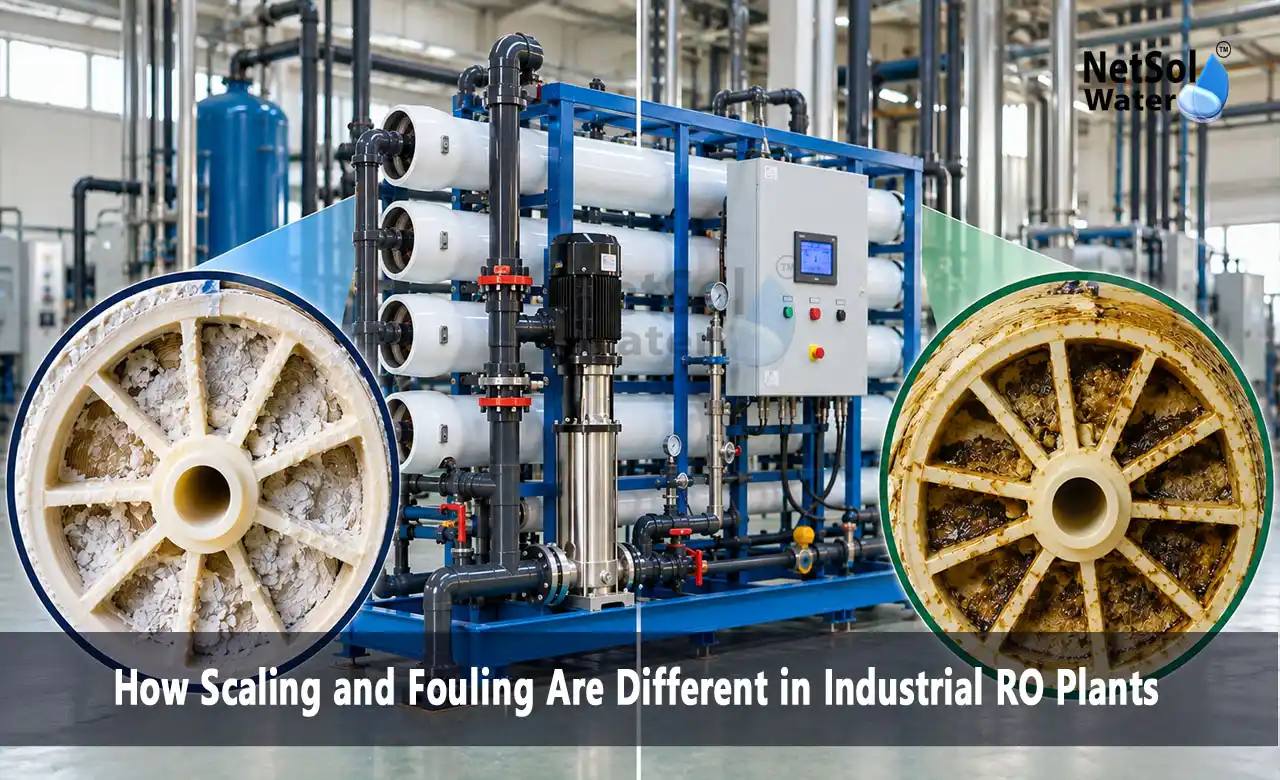
How Scaling and Fouling Are Different in Industrial RO Plants?
Industrial RO plants have become essential for industries where water quality directly impacts production output. Reverse osmosis systems help factories remove dissolved salts and unwanted impurities from feed water, supporting sectors such as manufacturing, pharmaceuticals, food processing, power generation, and wastewater reuse. Across India, industrial RO plants are widely installed wherever businesses need a reliable, continuous supply of treated water.
Netsol Water is a well-established name in water and wastewater treatment, manufacturing industrial RO systems across a range of capacities and applications. A properly maintained RO plant can deliver stable water quality over the long term, but two issues frequently affect membrane performance: RO scaling and membrane fouling. Both reduce water output and push up operating costs, yet they occur for very different reasons, and recognising that difference is what helps operators pick the right prevention and cleaning approach.
What Is RO Scaling?
RO scaling develops when dissolved minerals in the feed water crystallise and settle as a solid layer on the RO membrane surface. Since the membrane rejects most dissolved substances, these rejected salts keep concentrating in the reject stream as water passes through the system. Once certain salts cross their solubility limit, they precipitate out and form a hard mineral crust on the membrane.
Why scaling occurs: Scaling is largely a function of water chemistry and operating conditions. Running the plant at high recovery increases salt concentration inside the system, and shifts in pH can trigger the formation of specific mineral deposits. Calcium carbonate is one of the most common scale types, while silica and sulfate-based scales can create equally serious problems. Testing the feed water quality in advance helps identify which minerals pose the greatest risk, so operators can plan appropriate pretreatment: pH correction, softening, or antiscalant dosing.
How scaling affects performance: A scale layer restricts water flow across the membrane, so permeate output drops while the pressure needed to maintain production rises, and that means higher energy consumption. Left untreated for too long, scale deposits become harder to dissolve, often forcing operators into more frequent chemical cleaning cycles, which shortens membrane life. Studies referenced by the US EPA confirm that scaling is a recognised contributor to flux loss in RO systems.
What Is Membrane Fouling?
Membrane fouling is a separate but equally common problem. It happens when unwanted material accumulates on the membrane surface or gets lodged within the membrane structure itself. Unlike scaling, which is purely about mineral precipitation, fouling can originate from several different sources: suspended particles, colloids, organic matter, and biological growth. EPA documentation identifies particulates such as colloids and organic compounds as major drivers of membrane fouling.
Common causes of fouling:
. Particulate fouling: fine solids that slip through inadequate pretreatment and build up on the membrane
. Organic fouling: natural organic matter or other dissolved compounds that adhere to the membrane surface
. Biological fouling: bacterial growth that forms a biofilm, blocking the membrane and disrupting water flow
Each fouling type needs a distinct prevention and cleaning strategy, so identifying the source correctly matters.
How fouling affects performance: Fouling shrinks the effective membrane area, making it progressively harder for water to pass through. Operators typically see a gradual decline in permeate flow along with rising differential pressure as the fouling layer thickens. Research cited by the US EPA shows that severe fouling can noticeably impact both permeate output and system pressure in full-scale RO operations. Because lead elements in an RO train often bear the brunt of particulate load, they need closer monitoring and stronger pretreatment support.
Scaling vs Fouling: The Key Differences
Both problems can look similar on the surface: falling flow, rising pressure, and weakening overall performance. But their root causes are not the same, and that is exactly why the fix for one will not necessarily solve the other.
Scaling is driven by mineral chemistry: recovery rate, pH, and concentration inside the system. Managing it means controlling precipitation through antiscalants, softening, acid dosing, or adjusting operating parameters.
Fouling has broader origins: suspended solids, organics, and biological activity, none of which involve a mineral saturation point the way scale does. Controlling fouling depends far more on strong upfront pretreatment and consistent feed water quality monitoring, so problems are caught before they escalate.
How Pretreatment Helps Prevent Both
Good pretreatment is the first line of defence for any RO membrane, since it controls the conditions that let minerals and contaminants reach the membrane in the first place, making it a core part of reliable industrial RO plant operation.
. Monitoring feed water quality: Tracking parameters like hardness, silica, pH, turbidity, TDS, and organic content gives operators early insight into scaling and fouling risk. Based on these results, a treatment train can be built to match the feed water: filtration for suspended solids, carbon treatment for certain contaminants, softening for hardness, and antiscalant dosing where mineral precipitation is a concern.
. Ongoing monitoring and cleaning: Pretreatment reduces risk, but it does not remove the need for continuous monitoring. Tracking permeate flow, feed pressure, and differential pressure helps operators spot deviations early, whether they point to scaling or fouling. Acting quickly, before deposits harden, keeps cleaning manageable and protects membrane life. It is equally important to diagnose the actual cause before applying any cleaning chemical, since using the wrong treatment wastes resources and can even damage the membrane.
Conclusion
RO scaling and membrane fouling both hurt performance, but they develop through completely different mechanisms: scaling from mineral precipitation, fouling from the buildup of particles, organics, or biological matter. Understanding this distinction helps industries choose the right pretreatment, monitoring, and cleaning strategy, which in turn supports lower operating costs and longer membrane life. Since every water source brings its own chemistry and challenges, proper feed water analysis remains the starting point for getting this right.
For dependable performance from your industrial RO plant, it pays to choose the right system design and follow a planned maintenance schedule. Netsol Water designs and manufactures industrial RO solutions across multiple capacities and applications. Contact us to discuss your requirements or request a consultation.
Contact Netsol Water
Phone: +91-9650608473, Email: enquiry@netsolwater.com